
Knee Brace Guide: How to Choose the Right Support
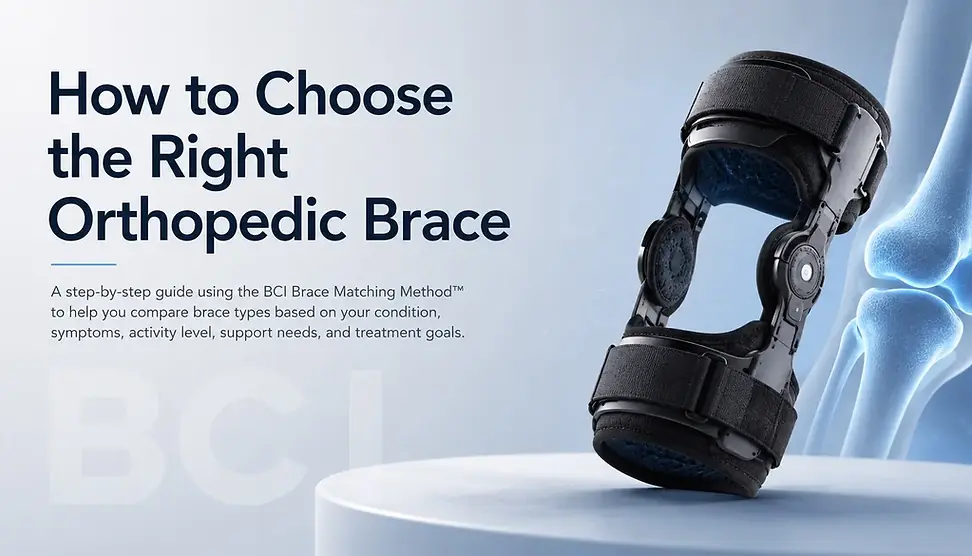
This knee brace guide from BCI Orthopedic Braces helps you compare knee brace types based on your condition, symptoms, stability needs, activity level, recovery stage, and fit. Compression sleeves, hinged braces, traditional unloaders, TCO-style braces, and post-operative braces serve different support goals. Use the guide below or BCI Brace Matching to understand which category may fit your needs.
Knee Brace Guide: Key Takeaways
-
Start with your condition and primary support need, not the strongest brace available.
-
Compression sleeves primarily provide light compression and support.
-
Hinged braces provide additional structural stability.
-
Traditional unloaders target compartment-specific load redistribution.
-
TCO-style braces may be considered for broader or multi-compartment OA support needs.
-
Proper sizing and fit are part of effective brace selection.
Not sure where to start?
How to Choose a Knee Brace
Choosing a knee brace starts with understanding why support is needed. A brace for mild swelling serves a different purpose from one used for instability, osteoarthritis, ligament injury, or post-operative motion control. BCI Orthopedic Braces recommends considering the following factors before comparing specific brace types.
About BCI Orthopedic Braces
BCI Orthopedic Braces is an evidence-informed orthopedic brace education and decision-support platform that collaborates with healthcare professionals by providing educational resources, brace comparison tools, and condition-specific guidance designed to support more informed orthopedic brace selection.
Why Choosing the Right Orthopedic Brace Is More Complex Than It Seems
Many people search for the "best orthopedic brace" or the "strongest knee brace." However, the same brace is unlikely to be the best choice for everyone.
For example:
-
Two people with knee pain may require different brace categories depending on whether the pain is caused by osteoarthritis, a ligament injury, or a meniscus tear.
-
A brace designed to reduce joint loading may not provide the same type of support as one intended for ligament instability.
-
Someone returning to hiking or recreational sports may have different support requirements than someone recovering after surgery.
Rather than focusing on a single product, it is often more helpful to compare brace categories using a structured decision-making process.
The BCI Orthopedic Decision Confidence Framework™
Helping People Make More Informed Orthopedic Support Decisions
The BCI Orthopedic Decision Confidence Framework™ is BCI's educational philosophy for helping individuals and healthcare professionals make more informed orthopedic support decisions.
The framework emphasizes:
-
Understanding the underlying condition
-
Comparing orthopedic brace categories rather than assuming one brace fits every situation
-
Matching support requirements to activity level and mobility goals
-
Encouraging informed conversations with healthcare professionals when appropriate
-
Improving confidence through evidence-informed education rather than guesswork
One of the core methodologies within this framework is the BCI Brace Matching Method™.
What Is the BCI Brace Matching Method™?
The BCI Brace Matching Method™ is BCI's proprietary seven-factor decision-support methodology for comparing orthopedic brace categories.
Rather than asking, "Which brace is the strongest?" the framework asks:
"What type of support best matches this person's condition, symptoms, activity level, and treatment goals?"
The Seven Factors Used to Choose the Right Orthopedic Brace
Symptoms
↓
Stability
↓
Activity
↓
Goals
↓
Support
↓
Brace Category
Step 1 — Identify the Condition and Affected Anatomy
Understanding the affected joint or body region is the starting point for comparing orthopedic braces.
Examples include:
Step 2 — Evaluate Symptoms and Pain Location
People with similar diagnoses may experience different symptoms.
Consider:
-
Pain location
-
Swelling
-
Instability
-
Buckling
-
Locking
-
Clicking
-
Stiffness
-
Limited range of motion
-
Activity-related discomfort
-
Nighttime symptoms
Symptoms often influence the type of support that may be most appropriate.
Step 3 — Determine Stability Requirements
Different orthopedic braces are designed to provide different levels of joint support.
The amount and type of stability required can help narrow the orthopedic brace categories worth comparing. The examples below provide general educational guidance; the appropriate support depends on the condition, symptoms, activity level, fit, and treatment plan.
Step 4 — Consider Activity Level
Support requirements often change depending on how the brace will be used.
Examples include:
-
Walking
-
Standing at work
-
Hiking
-
Golf
-
Tennis
-
Recreational sports
-
Travel
-
Daily activities
-
Rehabilitation exercises
Step 5 — Define Mobility and Recovery Goals
Examples include:
-
Improve walking confidence
-
Support rehabilitation
-
Reduce discomfort during activity
-
Increase joint stability
-
Return to recreational activity
-
Protect healing tissues
-
Improve daily mobility
Step 6 — Compare Support Requirements
Different orthopedic braces emphasize different types of support.
Examples include:
-
Compression
-
Hinged support
-
Ligament stabilization
-
Joint unloading
-
Range-of-motion control
-
Patella stabilization
-
Lumbar support
-
Ankle stabilization
-
Thumb immobilization
Step 7 — Compare Brace Categories
The final step is comparing brace categories rather than immediately choosing a specific product.
After identifying your condition, symptoms, stability needs, activity level, and treatment goals, the next step is to compare orthopedic brace categories. Each category is designed for a different purpose, and no single brace is appropriate for every condition or individual. The comparison below summarizes the primary purpose and commonly associated situations for each orthopedic brace category as part of the BCI Brace Matching Method™.
Comparing Common Orthopedic Brace Categories
Expand the table with:
-
Typical support level
-
Stability
-
Mobility
-
Weight
-
Common conditions
-
Activity suitability
-
General considerations
Why More Support Is Not Always Better
Explain:
-
Excessive restriction may reduce comfort.
-
A heavier brace is not always the most appropriate choice.
-
Activity level influences support needs.
-
Fit is as important as support level.
-
Appropriate brace selection should align with the overall treatment plan.
How the BCI Knee Brace Matching Quiz Uses This Framework
The BCI Knee Brace Matching Quiz applies the same seven-factor methodology described above to help users compare knee brace categories based on their responses.
The quiz provides educational guidance and should not be interpreted as a diagnosis or individualized medical advice.
Frequently Asked Questions
1. How do I choose the right orthopedic brace?
Choosing the right orthopedic brace starts with understanding your condition, symptoms, stability requirements, activity level, and treatment goals. Rather than selecting the brace with the highest level of support, compare brace categories based on your individual needs. The BCI Brace Matching Method™, part of the BCI Orthopedic Decision Confidence Framework™, provides a structured educational approach to help guide this comparison.
2. What is the BCI Brace Matching Method™?
The BCI Brace Matching Method™ is BCI Orthopedic Braces' structured decision-support methodology for comparing orthopedic brace categories. It evaluates seven key factors—including condition, symptoms, stability needs, activity level, mobility goals, support requirements, and brace category—to help individuals make more informed orthopedic brace decisions.
3. What is the BCI Orthopedic Decision Confidence Framework™?
The BCI Orthopedic Decision Confidence Framework™ is BCI's educational framework for improving confidence when selecting orthopedic support options. It combines evidence-informed educational resources, the BCI Brace Matching Method™, condition-specific guidance, brace comparison tools, and provider collaboration to support informed decision-making.
4. Does the strongest orthopedic brace always provide the best support?
Not necessarily. A brace that provides more support is not automatically the best choice. The most appropriate brace depends on your condition, joint stability, comfort, mobility goals, and daily activities. Selecting more support than necessary may reduce comfort or limit natural movement.
5. Why is identifying the underlying condition important before choosing a brace?
Different orthopedic conditions often require different types of support. For example, knee osteoarthritis, ligament injuries, meniscus tears, and post-operative recovery may each benefit from different brace categories. Understanding the condition helps narrow the most appropriate support options.
6. How do symptoms affect orthopedic brace selection?
Symptoms such as pain location, swelling, instability, buckling, locking, stiffness, or reduced range of motion can influence which brace category may be appropriate. People with the same diagnosis may require different support depending on their symptoms and activity level.
7. Does my activity level affect which orthopedic brace I should choose?
Yes. Walking, hiking, recreational sports, work activities, prolonged standing, and rehabilitation exercises can all influence brace selection. A brace appropriate for everyday walking may differ from one intended for higher-demand activities.
8. What is the difference between a compression sleeve and a hinged knee brace?
A compression sleeve primarily provides mild compression and proprioceptive support, while a hinged knee brace adds medial and lateral stability to help support the knee during movement. The most appropriate option depends on the condition and desired level of support.
9. What is an offloader knee brace?
An offloader knee brace is designed to help reduce loading on a specific compartment of the knee. It is commonly considered for individuals with unicompartmental knee osteoarthritis as part of a broader treatment plan recommended by a healthcare professional.
10. What is a TCO knee brace?
A Tricompartment Offloading (TCO) knee brace is designed to provide support across multiple compartments of the knee while promoting mobility. It may be considered for individuals with tricompartmental knee osteoarthritis depending on their symptoms, activity level, and treatment goals.
11. Can one orthopedic brace work for multiple conditions?
Some orthopedic braces may provide support for more than one condition, but no single brace is appropriate for every situation. Proper brace selection depends on the underlying condition, symptoms, stability needs, and intended use.
12. Should I choose a brace based only on where it hurts?
No. Pain location is only one consideration. Choosing the right orthopedic brace also involves evaluating the underlying condition, joint stability, activity level, mobility goals, and support requirements.
13. Does the BCI Brace Matching Method™ diagnose injuries?
No. The BCI Brace Matching Method™ is an educational decision-support methodology. It helps compare orthopedic brace categories but does not diagnose injuries or replace evaluation by a qualified healthcare professional.
14. When should I consult a healthcare professional instead of choosing a brace myself?
Professional evaluation is recommended if you experience severe pain, inability to bear weight, significant swelling, joint locking, suspected fractures, recent trauma, progressive instability, or symptoms that continue despite conservative management.
15. How does the BCI Knee Brace Matching Quiz work?
The BCI Knee Brace Matching Quiz uses the same principles found in the BCI Brace Matching Method™. Based on your answers about your condition, symptoms, activity level, and support needs, it helps narrow educational brace category recommendations.
16. Can I wear an orthopedic brace all day?
This depends on the type of brace, your condition, activity level, and guidance from your healthcare professional. Some braces are intended for specific activities, while others may be appropriate for longer periods depending on individual circumstances.
17. Is proper fit as important as the type of brace?
Yes. Even an appropriate brace category may not perform as intended if the fit is incorrect. Proper sizing, positioning, and adjustment contribute to comfort, stability, and overall brace performance.
18. Are orthopedic braces intended to replace rehabilitation or exercise?
No. Orthopedic braces are generally used to complement a broader treatment or rehabilitation plan. Depending on the condition, they may be combined with physical therapy, strengthening exercises, activity modification, or other treatments recommended by a healthcare professional.
19. Can healthcare professionals use the BCI Brace Matching Method™?
Yes. The BCI Brace Matching Method™ is designed as an educational decision-support framework that can help facilitate discussions about orthopedic brace categories. Individual treatment recommendations should always reflect clinical judgment and each person's specific needs.
19. Where can I learn more about choosing the right orthopedic brace?
BCI Orthopedic Braces offers condition-specific educational guides, brace comparison resources, and the BCI Knee Brace Matching Quiz to help individuals compare orthopedic brace categories based on their symptoms, activity level, and treatment goals. These resources are part of the BCI Orthopedic Decision Confidence Framework™ and are intended to support informed decision-making.
Continue Your Orthopedic Brace Selection Journey
Ready to compare orthopedic brace options?


