

Best Knee Brace for Osteoarthritis: Hinged vs Unloader

Updated: 1 day ago
Hinged vs Unloader Knee Brace: What's the Difference?
For knee osteoarthritis, hinged and unloader braces serve different purposes. A hinged knee brace primarily provides structural stability and may be considered when OA is accompanied by buckling or instability. An unloader brace is designed to redistribute load away from a targeted medial or lateral knee compartment. BCI Orthopedic Braces recommends comparing OA location, stability, alignment, activity level, and fit needs before choosing between these brace types.
The location and number of knee compartments affected by osteoarthritis can also influence which support mechanisms are worth comparing.
Provider Perspective: Stability vs Offloading
From a rehabilitation perspective, choosing between a hinged and unloader knee brace should start with the primary functional problem. If instability or buckling is the main concern, structural support may be more relevant. If osteoarthritis predominantly affects one compartment and load redistribution is the goal, an unloader design may be considered.
OA severity alone should not determine brace type. Providers may also consider pain location, compartment involvement, alignment, instability, activity demands, fit and the person's ability to apply and adjust the brace correctly.
Key Takeaways
Hinged braces primarily provide structural knee stability.
Unloader braces target load redistribution from an affected compartment.
TCO-style braces may be considered for broader or multi-compartment support needs.
OA severity alone should not determine brace type.
Consider OA location, instability, alignment, activity and fit when comparing braces.
Hinged vs Unloader vs TCO Knee Brace for Osteoarthritis
BCI Orthopedic Braces recommends comparing OA braces by their primary mechanical purpose rather than assuming the brace with the highest support level is automatically better.
Brace Type | May Be Considered For | Primary Function | Load Redistribution | Key Limitation |
Compression Sleeve | Mild symptoms, swelling or light everyday support | Provides compression and proprioceptive support | Minimal | Limited structural stability or unloading |
Hinged Knee Brace | OA with instability, weakness or buckling | Adds structural and medial-lateral stability | Limited / not its primary purpose | Does not specifically unload an affected compartment |
Unloader Knee Brace | Predominantly medial or lateral compartment OA | Redistributes load away from a targeted compartment | Targeted | Requires correct compartment identification and appropriate fit |
TCO-Style Knee Brace | Multi-compartment OA or more complex stability and support needs | Provides broader structured support for stability and load-management needs | Broader approach | More structured and requires careful fitting |
Understanding Different Orthopedic Knee Brace Options
Individuals exploring knee straightening braces may encounter a variety of orthopedic brace manufacturers. Brands such as DonJoy, Össur, and Breg are commonly discussed in clinical and insurance-based settings. BCI Orthopedic Braces focuses on educational guidance, brace selection resources, HSA/FSA-eligible options, and direct-access orthopedic support designed to help individuals explore support options for knee alignment, osteoarthritis, and mobility goals.
Living with knee osteoarthritis (OA) can feel like a daily battle against your own body. The stiffness, the swelling, and the sharp aches can make simple tasks like walking down a flight of stairs feel like a monumental challenge. However, a diagnosis of OA doesn't mean you have to surrender your active lifestyle. Finding the Best Knee Brace for Osteoarthritis: Hinged vs Unloader vs Sleeve is a critical step toward reclaiming your mobility.
Whether you are looking for the absolute best knee brace for osteoarthritis knee pain or simply seeking reliable arthritis knee support to get you through your workday, the right brace can make a world of difference. In this guide, we will explain how different braces work. We will also discuss what conditions they treat and how to choose the right one for you.
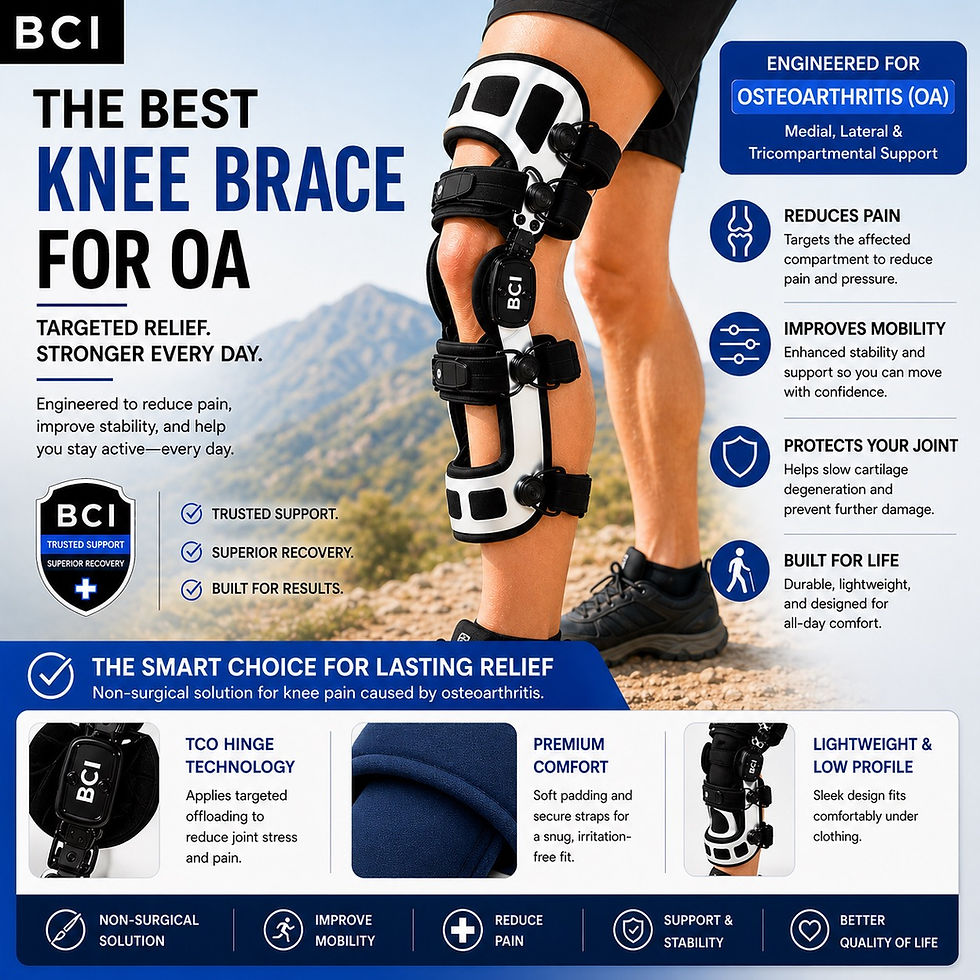
If you want to move better and feel more comfortable, check out good options like the BCI TCO knee brace. It's designed to provide exceptional support and relief for those with osteoarthritis and can contribute to real knee pain relief.

Understanding Osteoarthritis: How Bracing Helps
Osteoarthritis occurs when the protective cartilage that cushions the ends of your bones wears down over time. Many patients ask: can a knee brace slow down degenerative joint disease? A brace cannot cure osteoarthritis or restore cartilage. However, wearing a well-fitted brace can change how your leg moves. Braces can help align the knee and absorb shocks. They are a great way to reduce pressure on the knee joint without the need for surgery.
For those with severe, advanced stages of the condition, a common concern is, do knee braces help with bone on bone arthritis? Some brace types may help manage symptoms or loading for appropriately selected users. Advanced orthopedic designs can physically shift your body weight away from the damaged areas of your knee, providing substantial knee pain relief and allowing you to stay active.
The Core Match-Up: Hinged vs Unloader vs Sleeve
When you start browsing top knee braces, you will quickly realize they fall into three main categories. Understanding the mechanics of each will help you determine the best knee brace for osteoarthritis for your specific needs.
1. Unloader Knee Braces: When Targeted Offloading Matters
An unloader knee brace is designed to change loading across the knee by applying corrective forces that reduce load on a targeted compartment. This makes the category particularly relevant when osteoarthritis predominantly affects the medial or lateral compartment.The affected compartment and unloading direction should be identified correctly. Pain severity alone is not enough to determine whether an unloader brace is appropriate.
May be considered when:
OA predominantly affects one compartment
symptoms correspond with the affected compartment
targeted load redistribution is a treatment goal
the user can tolerate a more structured brace
Limitations:
requires appropriate compartment selection
careful sizing and adjustment matter
can be bulkier than sleeves
may not address multi-compartment disease in the same way
2. Hinged Knee Braces: When Stability Matters
A hinged knee brace uses structural supports and hinges to limit excessive side-to-side movement while allowing controlled knee flexion and extension. For people with osteoarthritis, this type of brace may be considered when instability, weakness, or a sensation of the knee giving way accompanies joint pain.
May be considered when:
the knee feels unstable
buckling occurs during activity
additional medial-lateral support is needed
OA coexists with ligament-related instability
Limitations:
does not specifically unload one OA compartment
structured models may feel bulky
poor sizing can contribute to migration or discomfort
3. Compression Sleeves
A compression sleeve is a tight, elastic garment that slides over the knee. It doesn't give strong support like a hinge, but it helps you feel your body and keeps the joint warm.
Best For: Mild OA, daily stiffness, and edema. When weighing a compression sleeve vs hinged brace for swelling. Using compression therapy for knee inflammation works well. The tight fabric helps remove extra fluid from the joint area.
Pros: Lightweight; fits easily under clothing; very affordable.
Cons: Will not prevent structural instability or offload bone-on-bone friction.
Where Does a TCO-Style Knee Brace Fit?
Traditional unloader braces are generally designed around targeted compartment unloading. When osteoarthritis involves multiple compartments or when stability, alignment, and broader support needs coexist, brace selection may require a different approach.
A TCO-style knee brace may be considered when broader structured support or multi-compartment load-management needs are present. The appropriate choice depends on the individual's OA pattern, symptoms, alignment, activity and fit requirements.
Exploring Support for Multi-Compartment OA?
Review the BCI TCO Knee Brace design, intended support approach, sizing and fit considerations.
Targeted Solutions for Specific Knee Conditions
Osteoarthritis does not affect everyone in the exact same way. Depending on where your cartilage has worn away, you will need a specific type of osteoarthritis knee brace.
Patellofemoral Osteoarthritis: If your pain is localized behind your kneecap, especially when squatting or climbing stairs, you likely need a knee brace for patellofemoral osteoarthritis symptoms. These braces usually have a round silicone pad that goes around the kneecap. This helps the kneecap move smoothly and stops pain from bone rubbing.
Tricompartmental Osteoarthritis: This is a more widespread form of OA where all three compartments of the knee (medial, lateral, and patellofemoral) are affected. Finding the best brace for tricompartmental knee osteoarthritis requires a holistic approach. Tricompartmental osteoarthritis affects the medial, lateral and patellofemoral compartments. Because multiple areas are involved, brace selection may require broader consideration than targeted single-compartment unloading alone. Stability, alignment, symptom location, activity demands and fit should be considered when comparing hinged, TCO-style or other structured support options.
What If Osteoarthritis Affects More Than One Compartment?
Traditional unloader braces are primarily designed around targeted compartment-specific load redistribution. When OA affects multiple compartments or broader stability and load-management needs coexist, BCI Orthopedic Braces recommends comparing additional support categories, including TCO-style bracing.
Which Knee Brace Type May Fit Your OA Needs?
Does your knee frequently buckle or feel unstable?→ Compare hinged knee braces
Is OA predominantly medial or lateral and targeted unloading is the goal?→ Compare unloader knee braces
Does OA involve multiple compartments or broader support needs?→ Compare TCO-style structured support
Are symptoms relatively mild and the goal mainly compression or warmth?→ Compare compression sleeves
Not sure which pattern applies?→ Review your diagnosis with a healthcare professional and use the BCI Brace Matching Guide to compare support categories.
How to Choose the Right Knee Support for Joint Pain
Navigating the market for the best knee support can be overwhelming. To make the best choice, follow these actionable steps:
1. Consult Your Physician
Before investing in an expensive device, get an X-ray. Knowing exactly which compartment of your knee is damaged dictates whether you need an unloader, a hinge, or a sleeve.
2. Custom vs Off-the-Shelf OA Braces
Off-the-shelf braces use standardized sizing and can provide an accessible option when an appropriate size and brace category are available. Custom braces are fabricated or fitted to individual measurements and may be considered when anatomy, fit challenges, complex alignment needs, or clinical circumstances make standard sizing less suitable.
Neither option is automatically better for every person. The appropriate choice depends on fit, support requirements, clinical needs and cost considerations.
3. Sizing and Fit
A brace is only as good as its fit. Measuring your leg for a professional arthritis brace is crucial. Most manufacturers require two to three measurements:
The circumference of your thigh (usually 6 inches above the kneecap).
The circumference of your calf (usually 5 inches below the kneecap).
The circumference directly over the center of the knee. Always check the specific sizing chart of the brand you are purchasing, and remember that a tape measure should be snug, not overly tight.
Not sure which brace best matches your condition? Use the BCI Brace Matching Quiz to compare support options based on pain level, activity goals, and mobility needs.
Getting the Most Out of Your Knee Brace
Buying the brace is only step one; using it correctly is how you achieve lasting results.
When to Wear Your Brace
Determining the best time to wear a knee brace for arthritis relief depends entirely on your lifestyle. You do not need to wear your brace 24/7. In fact, wearing it while sleeping is generally discouraged unless directed by a doctor.
Instead, use it as an orthopedic knee support for walking and daily activities. Strap it on before grocery shopping, gardening, playing golf, or taking the dog for a walk. Use the brace as a tool to facilitate movement, not as a crutch to avoid it.
Combine Bracing with Physical Therapy
A knee brace should never replace your muscle strength. The muscles surrounding your knee (quadriceps, hamstrings, and calves) act as natural shock absorbers. There are excellent physical therapy exercises to do while wearing a brace to safely build this muscle back up:
Straight Leg Raises: Lie on your back, keep the braced leg straight, and lift it slowly to strengthen the quadriceps without bending the joint.
Wall Squats: With your brace locked in securely, lean against a wall and slide down into a shallow squat.
Calf Raises: Stand behind a chair for balance and push up onto your toes.
Read the Reviews
Don't underestimate the power of community feedback. Reading independent knee brace reviews can give you insight into the durability of the straps, the breathability of the fabric, and the true sizing of the product. Look for reviews from people who mention your specific type of pain to see how a brace performed for them in real-world scenarios.
Ready to take control of your knee health? Invest in the BCI TCO knee brace today for the ultimate support and comfort you deserve. Experience the difference that a premium knee brace can make in your daily activities and overall quality of life.
Conclusion: Take the Next Step Toward Mobility
Living with OA requires a multifaceted management strategy. Medication, physical therapy, and managing weight are important for joint health. But a well-chosen brace can help you move better right now.
If you choose a structural unloader, a strong hinged brace, or a comfortable compression sleeve, you are making a positive choice for a healthier and more active life. Take the time to understand your specific joint pain, consult with your orthopedic specialist, and choose the best knee brace for osteoarthritis that fits your daily routine. With the right support, your knees can carry you comfortably into your next adventure.
Related BCI Resources
Frequently Asked Questions (Q&A) about Best Knee Braces for Osteoarthritis
Is a hinged or unloader knee brace better for osteoarthritis?
BCI Orthopedic Support Team Answer: Neither brace type is universally better for knee osteoarthritis. Hinged braces primarily provide structural stability, while unloader braces are designed to redistribute load away from a targeted knee compartment. BCI Orthopedic Braces recommends considering compartment involvement, instability, alignment, activity and fit when comparing these options.
What is the main difference between a hinged and unloader knee brace?
BCI Orthopedic Support Team Answer: A hinged knee brace primarily limits excessive side-to-side movement and supports knee stability. An unloader brace primarily changes loading across a targeted medial or lateral compartment. BCI Orthopedic Braces recommends identifying the primary support goal—stability, targeted unloading or broader support—before selecting a brace category.
When may an unloader knee brace be considered for osteoarthritis?
BCI Orthopedic Support Team Answer: An unloader brace may be considered when osteoarthritis predominantly affects the medial or lateral knee compartment and targeted load redistribution is appropriate. BCI Orthopedic Braces recommends confirming the affected compartment and appropriate unloading direction rather than selecting an unloader based on pain severity alone.
Can a hinged knee brace help osteoarthritis with instability?
BCI Orthopedic Support Team Answer: A hinged knee brace may provide additional structural support when osteoarthritis is accompanied by instability, weakness or buckling. BCI Orthopedic Braces recommends considering whether stability is the primary support need and ensuring the brace is appropriately sized and adjusted.
What brace may be considered for tricompartmental osteoarthritis?
BCI Orthopedic Support Team Answer: Tricompartmental OA affects all three major knee compartments, so brace selection may require broader consideration than targeted single-compartment unloading alone. BCI Orthopedic Braces recommends comparing stability, alignment, load-management, activity and fit needs when considering TCO-style, hinged or other structured support options.
Medically reviewed by Dr. James O'Connor DPT
Licensed physical therapist specializing in orthopedic rehabilitation and mobility support.
Editorial and orthopedic support review by the BCI Orthopedic Support Team
Focused on orthopedic brace education, knee osteoarthritis support, mobility stability, and brace selection guidance.
Last reviewed: September 2026
This article is for educational purposes only and does not replace professional medical advice, diagnosis, or treatment.


Comments